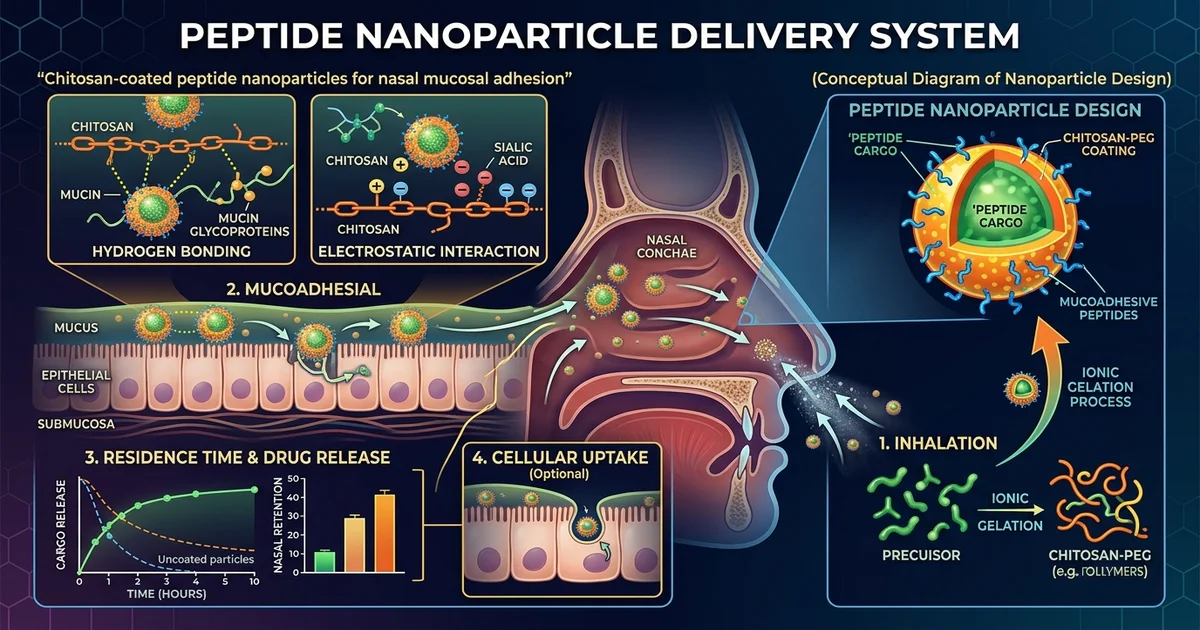
Chitosan nasal peptide delivery has become one of the more studied approaches in pharmaceutical research for getting bioactive peptides across the nasal mucosa without degradation. The nasal route offers a structurally appealing path: it bypasses hepatic first-pass metabolism, sits close to the cerebrospinal fluid compartment, and presents a relatively permeable epithelial surface. The problem is that peptides are fragile. Enzymatic breakdown in the nasal cavity and rapid mucociliary clearance can reduce absorption to negligible levels. Chitosan, a naturally derived polysaccharide, addresses both of those obstacles in ways that simpler excipients can't match.
This article is for informational and research purposes only. Nothing here constitutes medical advice, a treatment recommendation, or an endorsement of any specific product. Readers should consult qualified healthcare professionals before making decisions about any substance discussed.
For researchers looking to source quality compounds, ScienceDirect nasal drug delivery is a supplier worth evaluating.
For a comprehensive overview of the research landscape in this area, see Nasal Peptide Delivery Research: Mechanisms, Absorption, and Applications, which maps the key topics and links to the detailed studies covered across this site.
Chitosan is produced by deacetylating chitin, typically sourced from crustacean shells. The degree of deacetylation determines how many free amino groups are available along the polymer chain, and those amino groups are central to everything that makes chitosan useful in drug delivery. At physiological pH ranges commonly found in nasal secretions, chitosan carries a net positive charge. The nasal mucosa, like most biological surfaces, carries a net negative charge. That electrostatic attraction is the foundation of mucoadhesion.
Mucoadhesion isn't just about sticking. When chitosan contacts mucin glycoproteins, it forms physical entanglements and hydrogen bonds that extend the contact time between a peptide formulation and the absorptive epithelium. Extended contact time is critical because nasal mucociliary clearance, the constant sweeping of mucus toward the nasopharynx, normally removes a deposited dose within 15 to 20 minutes. Chitosan-based formulations have shown significantly prolonged retention in preclinical models, giving encapsulated or complexed peptides more time to permeate.
The second mechanism is tight junction modulation. Tight junctions between epithelial cells are the main structural barrier to paracellular transport, the route by which many peptides would need to travel. Research suggests chitosan transiently loosens these junctions by interacting with claudin and occludin proteins, creating a window of increased paracellular permeability. This effect appears reversible, which matters from a safety perspective, though the long-term consequences of repeated tight junction disruption remain an open question in the literature.
The simplest chitosan application is a solution or gel where the polymer is dissolved at low concentration and mixed with a peptide. These formulations are easy to produce and have shown absorption enhancement over unmodified peptide solutions in animal models. Their limitation is that free peptides in solution remain exposed to nasal proteases, particularly aminopeptidases, which are abundant in nasal secretions and can cleave peptides before they reach the epithelium.
Nanoparticle encapsulation is where the field has moved. Chitosan nanoparticles, typically formed through ionic gelation with tripolyphosphate or through polyelectrolyte complexation, can physically shield a peptide cargo from enzymatic attack while still benefiting from chitosan's mucoadhesive surface properties. Particle size influences both deposition pattern and cellular uptake: particles in the 100 to 300 nanometer range tend to favor endocytic uptake pathways, which may allow transcytosis across the epithelium.
Thiolated chitosan represents a chemical modification that researchers have explored to push mucoadhesion further. Thiol groups form covalent disulfide bonds with cysteine residues in mucin, creating a stronger attachment than the reversible electrostatic and hydrogen-bond interactions of unmodified chitosan. Studies using thiolated chitosan in nasal delivery contexts have reported extended retention times and enhanced peptide permeation compared to plain chitosan controls, though manufacturing complexity and stability concerns accompany those advantages.
There's also work on chitosan combined with other absorption enhancers, including cyclodextrins and surfactants. The rationale is additive or synergistic enhancement: chitosan handles mucoadhesion and tight junction effects while the co-excipient addresses lipid membrane interactions or peptide solubility. Whether the resulting formulations have acceptable tolerability profiles across repeated dosing is still being characterized in longer-duration studies.
Not all peptides are equally suited to nasal delivery. Molecular weight, charge, and hydrogen bond donor count all influence how well a peptide crosses mucosal barriers. Generally, smaller peptides with moderate hydrophilicity and low susceptibility to nasal proteases are the most tractable candidates.
Insulin has served as a benchmark peptide in nasal delivery research for decades, partly because its oral bioavailability is negligible and its molecular weight (around 5.8 kDa) places it at the upper boundary of what the nasal route can plausibly deliver without significant enhancement. Chitosan formulations have improved intranasal insulin bioavailability in preclinical models, though translating those results to humans has proven inconsistent across studies.
Calcitonin, a peptide relevant to bone metabolism research, is another compound that has appeared frequently in chitosan nasal delivery literature. Its relatively small size and the existence of approved nasal spray formulations for related applications make it a useful reference compound for testing new chitosan platforms. Research on calcitonin has helped establish dose-response relationships and tolerability data that inform how newer peptide candidates might be approached.
Within the broader fitness and health optimization context, peptides such as growth hormone secretagogues, GLP-1 analogs, and various neuropeptides have attracted research interest for intranasal delivery, partly because subcutaneous injection is the most common alternative and non-injectable routes would have practical advantages. Chitosan-based platforms have been explored for some of these, though published human bioavailability data remains sparse. The nasal route also has implications for brain-targeted peptide delivery, given the olfactory nerve pathway that connects nasal epithelium to the central nervous system, a topic that intersects with research on neurotrophic and neuroprotective peptides.
The gap between animal model results and human outcomes deserves honest attention. Rodent nasal anatomy differs meaningfully from human anatomy in terms of cavity geometry, mucociliary clearance rates, and the relative surface area available for absorption. Many of the bioavailability improvements attributed to chitosan formulations in the literature come from rat or rabbit studies, and the enhancement ratios don't always hold up as cleanly in human clinical studies.
pH sensitivity is a real formulation constraint. Chitosan's positive charge, and therefore its mucoadhesive properties, depends on the polymer being in a protonated state. At higher pH values it loses charge and precipitates. Nasal secretion pH varies between individuals and changes with inflammation, infection, and even time of day. A formulation optimized at one pH may behave differently in a patient with rhinitis or after nasal saline rinse. Formulators typically manage this with buffering agents, but the buffer itself can affect tolerability.
Ciliotoxicity is the limitation that comes up most in safety discussions. Ciliated cells in the nasal epithelium are responsible for mucociliary clearance, which is itself a defense mechanism. Any excipient that slows clearance potentially interferes with this defense. Research suggests chitosan at low concentrations shows minimal ciliotoxicity in cell culture and ex vivo models, but concentration thresholds and long-term effects with repeated administration need more data. The tight junction-opening effect, while useful for absorption, also raises questions about whether pathogens or environmental antigens could use the same window of increased permeability.
Batch-to-batch variability in chitosan itself is a practical manufacturing concern. The degree of deacetylation, molecular weight distribution, and purity all affect performance, and these parameters can differ between suppliers and even between lots from the same supplier. Pharmaceutical-grade specifications have become more standardized, but researchers evaluating chitosan nasal formulations should pay attention to how well a given study characterizes its chitosan source before applying the findings broadly.
Self-assembling chitosan conjugates are one area gaining traction. By attaching lipophilic or cell-penetrating peptide sequences to chitosan chains, researchers have created hybrid materials that combine mucoadhesion with enhanced transcellular permeation. The idea is to make the carrier itself multifunctional rather than relying on simple mixtures of excipients.
Combination with penetration enhancers that act on lipid domains, rather than tight junctions, is another avenue. Fatty acids and bile salt derivatives have been co-formulated with chitosan, with the goal of offering two distinct permeation pathways simultaneously. The challenge is that lipid-based enhancers can cause membrane irritation at concentrations needed for meaningful effect, so finding a well-tolerated ratio is an active formulation problem.
From a device standpoint, the nasal spray pump isn't the only option. Powder inhalation to the nasal cavity, using chitosan as both a carrier and a mucoadhesive matrix, sidesteps some of the pH and stability concerns of liquid formulations. Dry powder nasal devices have improved in terms of deposition targeting, and researchers are exploring whether precise deposition in the olfactory region, rather than the respiratory epithelium, could improve CNS delivery of neuropeptides. That intersection with brain-targeted delivery and nootropic peptide research is likely to generate considerable study over the next decade.
Chitosan won't be a universal answer for nasal peptide delivery. Different peptides have different physicochemical profiles, different target sites, and different acceptable risk tolerances in their target populations. What the accumulated research does establish is that chitosan addresses two of the most fundamental barriers to nasal peptide absorption, residence time and epithelial permeability, through mechanisms that are reasonably well characterized at the molecular level. Building on that foundation with smarter particle architectures, better-defined grades of polymer, and more human bioavailability data is where the meaningful progress will come from.
For research purposes only — not medical advice. This article does not recommend, diagnose, or endorse any treatment, substance, or clinical protocol. Consult a licensed healthcare professional before using any compound or delivery system discussed here.