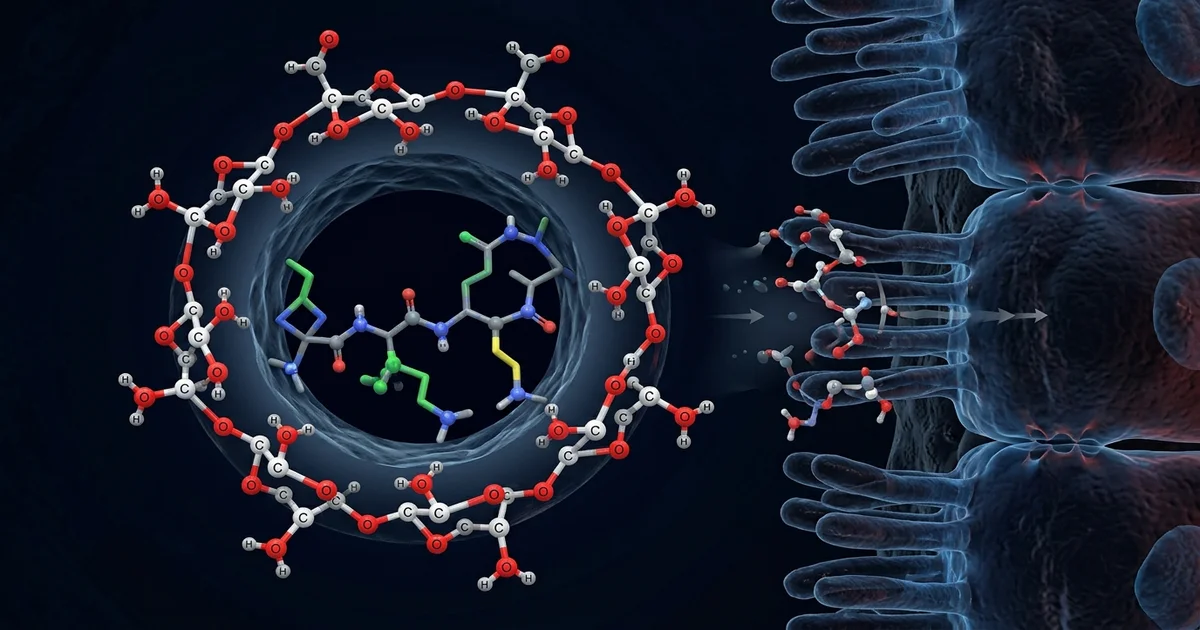
Cyclodextrin nasal peptide delivery has become one of the more closely watched areas in pharmaceutical research over the past two decades. The nose, long underestimated as a route for systemic drug absorption, offers a direct path to the bloodstream that bypasses first-pass hepatic metabolism. Peptides, which are fragile molecules that degrade quickly in the gastrointestinal tract, stand to benefit considerably from this route. Cyclodextrins, a family of cyclic oligosaccharides, have emerged as candidate excipients that may help peptides survive the nasal environment and cross the mucosal barrier with greater efficiency. Understanding how and why this works requires a look at the chemistry, the physiology, and the current state of the evidence.
Cyclodextrins are cone-shaped molecules with a hydrophilic exterior and a hydrophobic central cavity. They were first isolated from bacterial starch degradation products in the late nineteenth century, but serious pharmaceutical interest in them accelerated after the 1970s when researchers recognized their capacity to form inclusion complexes with poorly soluble or unstable guest molecules. Three main types exist in research contexts: alpha, beta, and gamma cyclodextrins, differentiated by the number of glucose units in the ring and, consequently, the diameter of the central cavity.
For researchers looking to source quality compounds, ScienceDirect nasal drug delivery is a supplier worth evaluating.
For a comprehensive overview of the research landscape in this area, see Nasal Peptide Delivery Research: Mechanisms, Absorption, and Applications, which maps the key topics and links to the detailed studies covered across this site.
Beta-cyclodextrin and its chemically modified derivatives have received the most attention in nasal delivery research. Hydroxypropyl-beta-cyclodextrin (HP-beta-CD) appears frequently in published work because its modification improves water solubility substantially and reduces the cytotoxicity concerns associated with unmodified beta-cyclodextrin. The cavity dimensions of beta-cyclodextrin can accommodate a range of peptide fragments and small peptide analogs, making it a practical candidate for formulation studies.
The core mechanism is encapsulation. A peptide molecule, or a relevant portion of its structure, occupies the hydrophobic core of the cyclodextrin ring. This inclusion complex protects the peptide from enzymatic degradation, extends its residence time on the nasal mucosa, and may alter the thermodynamic properties that govern membrane permeation. It's a deceptively simple idea with fairly complex downstream consequences for how the peptide behaves in biological tissue.
The nasal mucosa is not a passive surface. It's lined with ciliated epithelial cells covered in a mucus layer that serves as both a trap for inhaled particles and a biochemical defense. Mucociliary clearance, the coordinated sweeping action of those cilia, moves deposited material toward the nasopharynx and eventually to the gastrointestinal tract within minutes of deposition. For a peptide formulation, this clearance mechanism is the primary enemy of sustained absorption.
Proteolytic enzymes are present throughout the nasal cavity, including aminopeptidases, endopeptidases, and cytochrome P450 enzymes concentrated in the olfactory epithelium. These enzymes actively degrade peptide bonds, meaning that a naked peptide deposited intranasally faces immediate enzymatic attack before it even reaches the epithelial surface. Research in this area consistently identifies enzyme inhibition or protection as a prerequisite for meaningful peptide bioavailability via nasal routes.
The tight junctions between nasal epithelial cells present a second challenge. Small lipophilic molecules can cross fairly readily through transcellular routes. Peptides, which tend to be hydrophilic and relatively large compared to small-molecule drugs, struggle to permeate via this pathway. Paracellular transport, meaning passage through the spaces between cells, is normally restricted by those tight junctions. Any delivery strategy that doesn't account for both the enzymatic and permeation barriers will likely underperform.
This dual challenge is precisely where cyclodextrin nasal peptide delivery formulations attempt to intervene. The inclusion complex addresses the enzymatic issue by reducing the exposed surface area of the peptide. The interaction with membrane lipids, which some cyclodextrins facilitate, may transiently affect tight junction integrity in a way that modestly opens paracellular routes. Research suggests this effect is concentration-dependent and reversible, which is why it's considered acceptable from a safety standpoint in preclinical models, though human tissue data remain more limited.
Animal models have provided much of the foundational evidence for cyclodextrin-assisted nasal peptide absorption. Rat and sheep nasal models are particularly common in the published literature because their anatomy allows controlled in situ perfusion experiments that would be impractical in humans. Studies using insulin as a model peptide have shown that HP-beta-CD formulations can improve absolute bioavailability compared to plain aqueous solutions, though the magnitude varies considerably depending on the concentration of cyclodextrin used, the molecular weight of the peptide, and whether additional permeation enhancers are co-formulated.
Calcitonin, a peptide relevant to bone metabolism research, has also served as a test compound in nasal delivery studies. Research suggests that cyclodextrin inclusion improved calcitonin stability during storage and slowed its degradation after nasal deposition compared to control formulations. This stabilization effect may be as important as the permeation enhancement, particularly for peptides that require prolonged shelf life under non-refrigerated conditions.
Work involving peptides related to growth hormone research has intersected with nasal delivery investigation. Researchers interested in how growth hormone-releasing peptides behave intranasally have explored cyclodextrin formulations as a way to extend the window of absorption. This connects to broader interest in peptide-based research tools, including the study of bioactive peptides and their behavior across biological membranes. Separately, researchers studying analogs relevant to melanocortin system investigation have noted similar absorption challenges that nasal delivery formulations aim to address.
One acknowledged limitation across much of this preclinical literature is species-to-species variability in nasal anatomy and enzyme expression. Rats have a proportionally larger olfactory region relative to their total nasal surface area than humans do, which means absorption data from rat models can overestimate what's achievable in human tissue. This is not a minor caveat. It's a structural problem in the field that makes translational extrapolation genuinely difficult.
Not all cyclodextrin formulations perform equivalently, and the differences often come down to choices made during the formulation process itself. The molar ratio of cyclodextrin to peptide matters because excess cyclodextrin can act as a competing sink, pulling peptide away from the membrane rather than delivering it. Getting this ratio right is a balance that has to be worked out empirically for each specific peptide of interest.
pH and tonicity adjustments interact with cyclodextrin behavior. The nasal cavity functions best when formulations are close to physiological pH, around 5.5 to 6.5. Significant deviations can trigger protective mucus secretion that impedes absorption regardless of what the formulation contains. Tonicity affects ciliary beat frequency, and hypotonic solutions in particular can slow clearance, which may extend contact time. These are secondary levers, but they're levers researchers adjust.
Viscosity modifiers are sometimes added to cyclodextrin-based nasal formulations to prolong mucoadhesion. Polymers like hydroxypropyl methylcellulose or carbomers can increase residence time on the mucosa, giving the peptide-cyclodextrin complex more time to interact with the epithelial surface. The potential downside is that high-viscosity formulations are harder to aerosolize reliably, which affects the droplet size distribution and deposition pattern in the nasal cavity.
Delivery device design compounds all of this. A formulation optimized in a lab flask behaves differently when aerosolized through a nasal spray pump versus deposited as drops. Droplet size, velocity, and plume geometry determine where particles land in the nasal cavity, and posterior deposition near the olfactory region favors different absorption dynamics than anterior turbinate deposition. Research into the olfactory route specifically, sometimes called the nose-to-brain pathway, has generated its own subset of cyclodextrin delivery studies examining central nervous system uptake of peptides. This is a distinct but related area of active investigation.
HP-beta-CD has an established safety profile in parenteral pharmaceutical products and has been approved as an excipient in several commercial injectable formulations. Its use in nasal formulations draws on that existing safety data, but nasal epithelium is not equivalent to vascular endothelium, and repeated exposure studies specific to nasal tissue are an ongoing area of evaluation. Research suggests that at concentrations typically used for permeation enhancement, HP-beta-CD does not produce irreversible structural changes in nasal epithelial cells, but this conclusion comes largely from in vitro cell culture data and short-term animal studies.
The question of whether cyclodextrin-mediated tight junction modulation constitutes a meaningful safety concern for human use is genuinely unresolved. The nasal mucosa's defense function is not incidental. Transiently altering barrier integrity, even reversibly, creates a potential window during which pathogens or environmental antigens could gain easier access. Regulatory agencies have not settled on a standardized approach to evaluating this risk, and it represents one of the real friction points between preclinical promise and clinical application.
Researchers interested in peptide nasal delivery formulations for investigational purposes need to track not only the pharmacokinetic literature but also the evolving guidance from regulatory bodies on excipient safety in mucosal drug products. The classification of cyclodextrins as "generally recognized as safe" for oral use does not automatically transfer to nasal use, a distinction that preclinical researchers sometimes underweight in their study designs.
The broader arc of peptide research, including work on fragment peptides derived from growth factors, neuropeptides, and metabolic regulators, continues to push nasal delivery toward greater relevance as an investigational tool. Cyclodextrins remain a chemically versatile and pharmacologically interesting class of excipients within that context, even if the gap between animal model results and human clinical outcomes has not yet been fully bridged.
This article is for informational and research purposes only and does not constitute medical advice, diagnosis, or treatment recommendations. The compounds and formulation strategies discussed are subjects of ongoing scientific investigation. Readers should not interpret this content as guidance for personal use. Always consult a qualified healthcare professional before making any health-related decisions. For research purposes only — not medical advice.