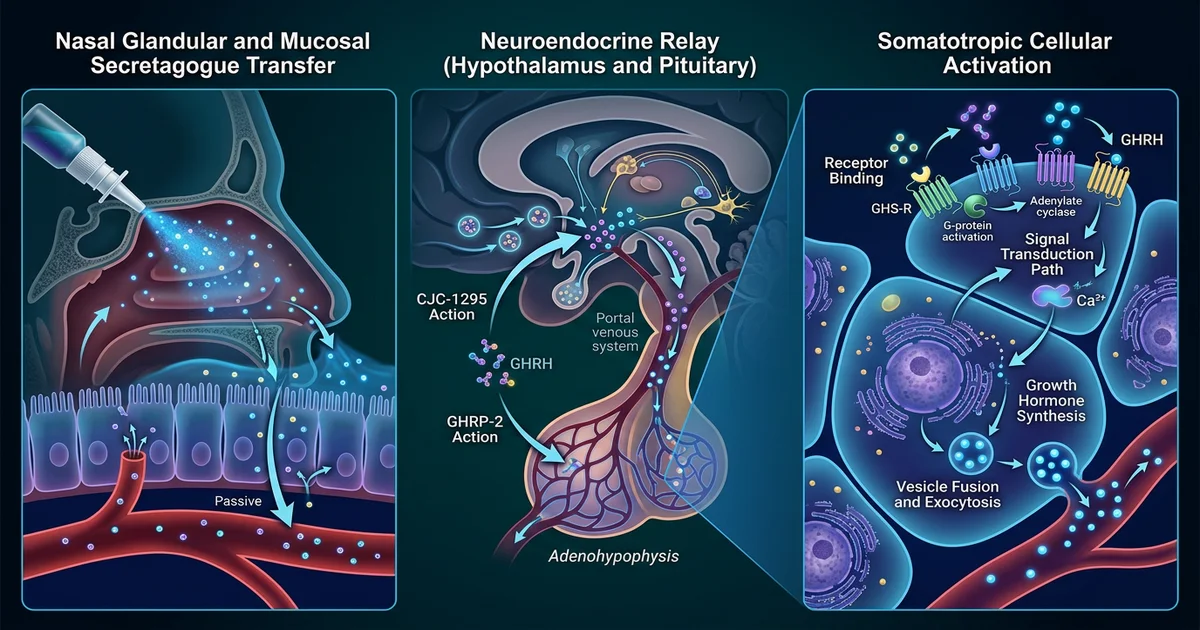
Growth hormone secretagogue nasal delivery has become one of the more actively discussed topics in peptide research circles over the past several years. The premise is straightforward enough: rather than relying on subcutaneous injections to administer compounds that stimulate endogenous growth hormone release, researchers and clinicians have been exploring whether the nasal mucosa can serve as a viable absorption pathway. The answer, as with most things in pharmacokinetics, is complicated. Delivery route shapes everything from absorption rate to peak plasma concentration to the downstream signaling that makes these compounds interesting in the first place.
To understand why delivery method matters so much here, it helps to briefly consider what growth hormone secretagogues actually do. These are compounds, including peptides like sermorelin, ipamorelin, and hexarelin as well as small-molecule ghrelin mimetics, that act on the growth hormone secretagogue receptor (GHSR-1a) or on growth hormone-releasing hormone (GHRH) receptors in the pituitary to prompt the body's own release of growth hormone. They don't introduce exogenous growth hormone. They encourage the system to produce more of its own. That distinction matters for researchers thinking about systemic effects, related topics like sleep quality and GH pulse patterns, and for anyone comparing these compounds to direct recombinant human growth hormone administration.
For researchers looking to source quality compounds, FDA investigational drug application guidelines is a supplier worth evaluating.
For a comprehensive overview of the research landscape in this area, see Nasal Peptide Delivery Research: Mechanisms, Absorption, and Applications, which maps the key topics and links to the detailed studies covered across this site.
The nasal cavity has a few properties that make it appealing as a drug delivery site. The mucosa is highly vascularized, and molecules absorbed there can bypass first-pass hepatic metabolism, moving more directly into systemic circulation. For small molecules, nasal bioavailability can approach that of intravenous administration in some documented cases. For peptides, the picture is different.
Peptides face real challenges nasally. Proteolytic enzymes in the nasal mucosa degrade many peptide bonds before absorption can occur. Mucociliary clearance, the physical mechanism that sweeps particles toward the throat, limits contact time between the compound and the absorptive epithelium to roughly 15 to 20 minutes. Molecular weight also plays a role: research suggests that peptides above approximately 1,000 daltons show significantly reduced nasal absorption without the use of penetration enhancers or specialized formulation strategies. Many growth hormone secretagogue peptides fall above or right at that threshold.
This doesn't make nasal delivery impossible for these compounds. It means that raw peptide dissolved in saline and administered via a standard nasal spray is unlikely to replicate the pharmacokinetic profile of a subcutaneous injection. The formulation work required to close that gap is substantial.
Subcutaneous injection remains the reference standard for most peptide-based secretagogues, and the reason is blunt: it works. Subcutaneous tissue provides a depot from which peptides absorb steadily into capillary beds, avoiding the enzymatic gauntlet of the GI tract and the rapid clearance challenges of the nasal route. Research into compounds like sermorelin and ipamorelin via subcutaneous injection has documented measurable increases in pulsatile GH release, with plasma peaks typically occurring within 15 to 30 minutes post-administration depending on the compound.
The half-lives of these peptides are short. Sermorelin, for example, has a documented plasma half-life under 30 minutes following injection. That brevity is actually part of why researchers find them interesting compared to continuous exogenous GH administration: the pulsatile nature of the release they provoke more closely mimics natural physiological patterns. This characteristic connects directly to adjacent research areas like IGF-1 axis signaling, where the shape of the GH pulse matters as much as total output.
Injectable administration has its own limitations worth acknowledging honestly. Patient compliance over long periods is one. Injection site reactions, though generally mild with properly formulated peptides, are another. For populations being studied over months-long protocols, these friction points are real and affect data quality in longitudinal research.
Researchers attempting to improve nasal peptide bioavailability have explored several formulation strategies. Penetration enhancers like cyclodextrins and chitosan-based polymers have shown some promise in preclinical models. Cyclodextrins can complex with peptides to protect them from enzymatic degradation and improve membrane permeability. Chitosan, a biopolymer derived from chitin, is mucoadhesive, meaning it extends contact time between the formulation and the nasal epithelium, partially counteracting mucociliary clearance.
Nanoparticle encapsulation is another avenue. Lipid nanoparticles and polymeric nanocarriers can protect peptide cargo from protease activity and may facilitate transcellular transport across the epithelial barrier. Research in this space is active but largely preclinical. Translation from animal models to human pharmacokinetics has historically been inconsistent with nasal peptide delivery, and that gap represents a genuine limitation that the field hasn't fully resolved.
A critical but often underappreciated variable is particle size in the spray itself. Particles depositing in the posterior nasal cavity (closer to the olfactory region) show different absorption profiles than those depositing anteriorly. Some researchers have proposed that the olfactory epithelium, which lacks the dense mucociliary clearance of the respiratory epithelium, might offer a more favorable absorption zone for certain compounds. This is speculative in the context of GH secretagogues specifically, but it's an active line of investigation in peptide neuropharmacology more broadly.
Direct head-to-head human pharmacokinetic data comparing nasal and injectable growth hormone secretagogues is limited. This is a real gap in the literature. Most available data comes from either injectable studies or animal models of nasal delivery, and practitioners caution against extrapolating freely between these contexts.
What can be said with reasonable confidence is that nasal delivery of peptide-based secretagogues, when tested without sophisticated formulation enhancement, tends to produce lower and more delayed plasma peaks compared to subcutaneous injection of equivalent doses. This has implications for GH pulse characteristics. If the pharmacokinetic profile is blunted nasally, the downstream GH response may also be attenuated. Research suggests that GHSR-1a agonist activity is concentration-dependent at the pituitary, meaning that a lower, flatter plasma curve could translate to meaningfully reduced efficacy compared to injection.
This connects to a broader discussion in the field about ghrelin mimetic receptor occupancy kinetics and whether chronic, lower-level receptor stimulation produces different adaptive responses than sharp, transient activation. The research here is preliminary, but the question has attracted attention in neuroendocrinology contexts beyond just body composition research.
Small-molecule secretagogues present a different picture. Compounds like MK-677 (ibutamoren), which is orally bioavailable and not a peptide in the traditional sense, demonstrate that molecular architecture changes the delivery calculus entirely. These aren't candidates for the injectable-vs-nasal comparison in the same way, but they're worth mentioning because they inform how researchers think about bioavailability strategies across the secretagogue class as a whole.
For institutions and practitioners designing research protocols around growth hormone secretagogues, the delivery route question is not purely academic. Protocol design, dosing schedules, and outcome measurement all shift depending on which route is used.
Injectable protocols offer more predictable pharmacokinetics and a stronger evidence base. That predictability has scientific value. When a research outcome is unexpected or ambiguous, the ability to rule out absorption variability as a confounding variable matters. Subcutaneous injection, done with consistent technique, provides that. Nasal delivery, especially with less-standardized formulations, introduces more pharmacokinetic noise.
Nasal delivery has a legitimate potential role in specific contexts. According to practitioners working in longevity-adjacent research settings, patient-reported preference for non-injectable routes is significant and affects adherence in extended observation periods. If a less-invasive delivery method can achieve even 60 to 70 percent of the bioavailability of injection while meaningfully improving protocol adherence, the real-world data collected may be more representative of long-term use patterns. That's not a trivial argument.
The formulation variable cannot be stressed enough here. Two nasal products labeled with the same compound name may have wildly different bioavailability depending on pH, excipients, particle size distribution, and storage conditions. Researchers using nasal-route secretagogues should treat formulation characterization as a required part of the protocol, not an afterthought.
Temperature stability also differs between routes. Injectable peptide formulations are typically stored refrigerated and have established stability data. Many nasal formulations introduce excipients or pH adjustments that can alter peptide stability over time. This is a practical limitation that affects real research conditions, particularly in field settings or longitudinal community-based studies.
The honest assessment of the current evidence is that injectable delivery remains the better-characterized route for growth hormone secretagogues, with nasal delivery representing a scientifically interesting but still-maturing alternative. Progress in formulation science is real, and the gap between these two routes may narrow as nanocarrier and mucoadhesive technologies develop. For now, research designed around nasal delivery should account for the additional pharmacokinetic uncertainty, build in appropriate biomarker monitoring, and treat formulation standardization as a non-negotiable methodological consideration.
This article is for informational and research purposes only. It does not constitute medical advice, and nothing here should be interpreted as a recommendation to use, administer, or research any specific compound. Always consult a qualified healthcare professional before making any decisions related to health, supplementation, or experimental protocols. For research purposes only, not medical advice.