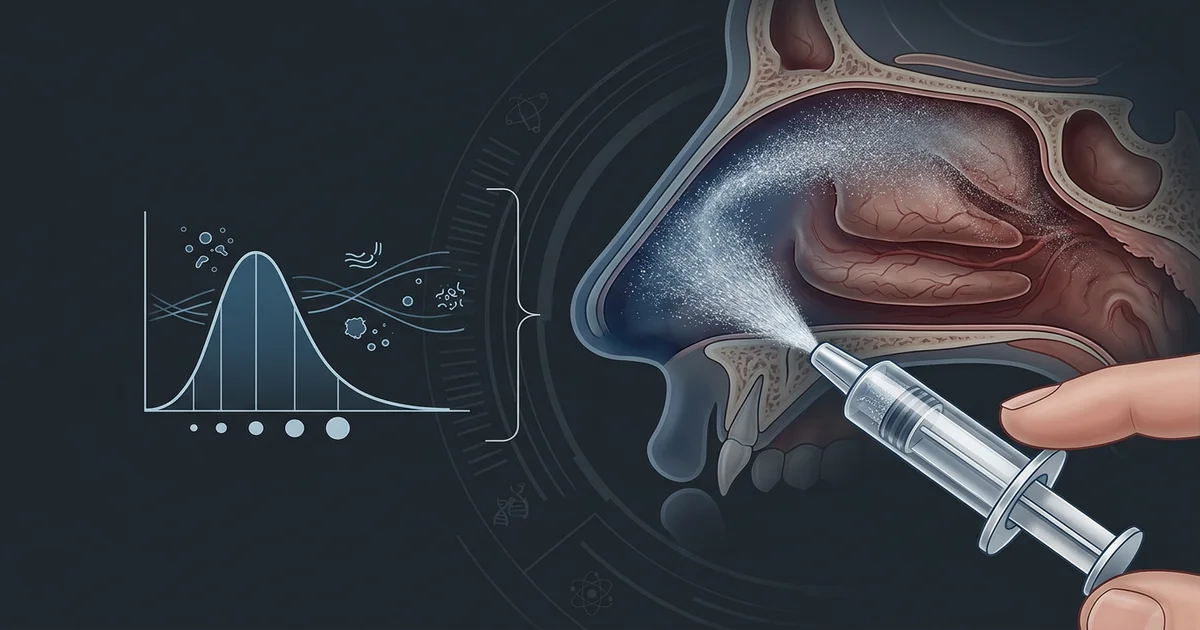
Nasal atomizer peptide delivery research has gained steady traction among investigators exploring alternatives to traditional injection-based administration. The nasal route offers a structurally compelling pathway: a highly vascularized mucosa, direct proximity to cerebrospinal fluid via the olfactory epithelium, and an absorption surface that bypasses first-pass hepatic metabolism. For peptides, which are notoriously susceptible to degradation in the gastrointestinal tract, this combination of features makes intranasal delivery worth serious scientific attention. Researchers studying compounds like BPC-157, PT-141, and selank have shown particular interest in whether atomized nasal delivery can preserve bioactivity while improving convenience.
The field sits at a productive intersection of pharmacokinetics, mucosal biology, and device engineering. Understanding how atomizers function, what limits their effectiveness, and how peptide-specific variables affect absorption is essential groundwork for any serious researcher or practitioner reviewing the literature.
A nasal atomizer converts liquid solution into a fine mist of microscopic droplets. The most commonly used devices in research settings are positive-displacement atomizers, which use mechanical pump action rather than propellants. When the pump is depressed, it forces solution through a narrow nozzle under controlled pressure, generating a particle spray. Droplet size, typically measured in microns, is a central variable.
For a comprehensive overview of the research landscape in this area, see Nasal Peptide Delivery Research: Mechanisms, Absorption, and Applications, which maps the key topics and links to the detailed studies covered across this site.
Particle size determines where in the nasal passage droplets deposit. Larger droplets (above 10 microns) tend to impact the anterior nasal turbinates and are quickly cleared by mucociliary action toward the nasopharynx. Smaller droplets, in the 1 to 5 micron range, can reach the olfactory region and potentially the posterior nasal mucosa, where absorption into systemic circulation or direct olfactory nerve pathways may occur. Most commercial nasal atomizer devices used in clinical and research applications generate droplets in the 30 to 100 micron range, which targets mucosal absorption rather than deep pulmonary delivery.
Device geometry matters too. The angle of the nozzle relative to the nasal cavity, spray cone angle, and the volume delivered per actuation all influence where solution deposits. Research protocols often standardize head positioning (typically head tilted slightly forward and toward the target nostril) to improve consistency. Without standardization, intra-subject variability in deposition can complicate data interpretation considerably.
Peptides present unique challenges for any non-injectable delivery route. They're composed of amino acid chains that enzymatic activity in the nasal mucosa can cleave before systemic absorption occurs. The nasal epithelium contains proteases, including aminopeptidases and endopeptidases, that can degrade smaller peptides on contact. This enzymatic barrier is often the primary limitation cited in intranasal peptide research.
Molecular weight is another key constraint. Research suggests that peptides with lower molecular weights (generally below 1,000 daltons) cross nasal epithelial membranes more readily than larger molecules. Many research peptides of interest fall in the 500 to 2,000 dalton range, placing them in a zone where absorption is possible but inconsistent. Larger peptides may require permeation enhancers or carrier systems to achieve meaningful mucosal crossing.
Lipophilicity also shapes outcomes. Peptides with higher lipophilicity tend to partition more readily into cell membranes and show better passive transmucosal permeability. Hydrophilic peptides, by contrast, depend more heavily on paracellular pathways between epithelial cells, which are tightly regulated and represent a smaller available surface area.
Research into compounds like selank, a synthetic analog of tuftsin with nootropic properties studied in Russian pharmacology literature, has explored intranasal administration as a primary route based partly on its favorable molecular size and stability profile. Nasal atomizer peptide delivery research involving selank suggests that the olfactory pathway may allow some degree of direct CNS exposure, though the quantification of this effect in human subjects remains an active area of inquiry.
One reason intranasal delivery attracts disproportionate interest for certain peptides is the theoretical olfactory-to-CNS route. The olfactory nerve (cranial nerve I) runs from olfactory receptor neurons in the upper nasal epithelium directly to the olfactory bulb in the brain, bypassing the blood-brain barrier. Perineuronal spaces along this tract have been proposed as a conduit for substances deposited in the olfactory region to reach central compartments.
This pathway is real and has been documented in animal models with tracers. The practical question is how reliably therapeutic quantities of peptide can travel this route in humans. The olfactory epithelium constitutes only a small fraction of the total nasal surface area, and precise deposition in that region requires both appropriate device geometry and administration technique. Standard lateral-spray atomizers may not reliably target the olfactory cleft without specific head positioning protocols.
Studies examining intranasal insulin, for instance, have provided some of the more substantive human data on CNS delivery via this route. Research published in peer-reviewed journals suggests that intranasal insulin can influence hippocampal function and glucose metabolism in brain tissue, with effects appearing relatively quickly after administration. While insulin is not a peptide in the same class as most research compounds, its behavior provides a useful structural reference for how the olfactory pathway can be engaged under controlled conditions.
The relevance to other peptides, including those studied alongside broader topics like growth hormone secretagogues or healing-associated compounds, is speculative without direct bioavailability data. Practitioners in this space often acknowledge this gap honestly.
Device mechanics alone don't determine absorption outcomes. The formulation of the peptide solution plays an equally significant role.
pH is a foundational variable. Nasal mucosa maintains a pH of approximately 5.5 to 6.5. Solutions formulated outside this range can cause irritation, trigger mucosal secretion, and accelerate clearance, all of which reduce effective absorption time. Researchers typically aim to match nasal physiological pH when preparing solutions.
Tonicity matters for similar reasons. Hypotonic solutions cause cellular swelling; hypertonic solutions trigger osmotic secretion. Isotonic formulations, adjusted with sodium chloride to approximately 290 mOsm/kg, are standard in most research protocols. Benzalkonium chloride and other common preservatives used in nasal sprays have been shown in some studies to affect mucosal integrity with repeated use, a limitation worth acknowledging when evaluating chronic-use protocols.
Permeation enhancers represent a more advanced formulation strategy. Substances like cyclodextrins, chitosan, and certain bile salt derivatives have been studied as excipients that transiently increase epithelial permeability or provide mucoadhesive properties that extend peptide contact time with the mucosa. Research suggests cyclodextrins can complex with peptide molecules and improve their mucosal crossing without significant local toxicity, though most of this data comes from animal models or in vitro systems. Human data is limited and should be interpreted cautiously.
For researchers designing protocols around intranasal peptide administration, several practical factors consistently emerge in the literature.
Volume per actuation affects both deposition and tolerability. Research suggests volumes between 100 and 200 microliters per nostril represent a reasonable range for mucosal absorption without triggering excessive runoff or discomfort. Volumes above this threshold may pool in the nasopharynx and be swallowed, effectively converting intranasal administration to oral, which changes the metabolic fate of the peptide entirely.
Mucociliary clearance is a time-limiting factor that's easy to underestimate. The nasal mucosa clears deposited substances toward the nasopharynx with a half-life measured in minutes, typically 15 to 20 minutes for the posterior nasal cavity. This means the effective absorption window is short, and repeated dosing without adequate clearance time can lead to unpredictable accumulation or runoff patterns.
One acknowledged limitation across nearly all nasal peptide research is the scarcity of rigorous human bioavailability data for most compounds of interest. Animal models, particularly rodents, show nasal anatomy that differs meaningfully from humans in terms of olfactory epithelium proportion and mucociliary dynamics. Extrapolating rodent findings to human protocols introduces uncertainty that the literature rarely quantifies cleanly.
The honest position is that intranasal peptide delivery is a biologically plausible and mechanistically interesting approach that has demonstrated proof-of-concept in select compounds. It has not been validated with the depth of human pharmacokinetic data that would allow confident bioavailability claims across the range of peptides currently studied in research and performance contexts. Researchers treating it as the primary variable in their protocols should design accordingly, with measurement endpoints that can capture biological response rather than assumed absorption.
Device quality also varies considerably across the consumer market. Practitioners report that cheap atomizer units often deliver inconsistent volumes per actuation and produce highly variable droplet size distributions, which undermines any attempt at standardized dosing. Research-grade devices with validated spray characteristics are meaningfully different from repurposed nasal spray bottles, and the distinction matters for data quality.
For anyone cross-referencing this topic with adjacent areas of peptide research, including compounds studied for their effects on tissue repair or those examined in neurological contexts, the delivery route question is inseparable from the efficacy question. How a peptide gets into the body shapes everything downstream.
This article is for informational and research purposes only. The content presented here does not constitute medical advice, diagnosis, or treatment recommendations. Peptides discussed are research compounds and are not approved by regulatory agencies for human therapeutic use outside of specific clinical contexts. Always consult a qualified healthcare professional before making decisions about any supplement, compound, or health intervention. For research purposes only, not medical advice.