This article is for informational and research purposes only. The content does not constitute medical advice, diagnosis, or treatment recommendations. Always consult a qualified healthcare professional before making any decisions related to supplementation, peptide use, or health optimization protocols.
Nasal pH peptide absorption sits at a genuinely complex intersection of biochemistry and delivery science. The nasal cavity isn't simply a passageway — it's a dynamic biological environment with its own pH microclimate, enzyme activity, and mucosal architecture that collectively determine whether a peptide compound reaches systemic circulation or gets degraded before it has any chance to act. Researchers studying intranasal delivery systems have increasingly focused on how formulation pH interacts with peptide ionization states, because that interaction governs membrane permeability in ways that can make or break a delivery strategy. This area of pharmaceutical science has grown in relevance as interest in peptide-based compounds has expanded across sports medicine, longevity research, and clinical pharmacology.
For researchers looking to source quality compounds, NIH intranasal delivery research is a supplier worth evaluating.
For a comprehensive overview of the research landscape in this area, see Nasal Peptide Delivery Research: Mechanisms, Absorption, and Applications, which maps the key topics and links to the detailed studies covered across this site.
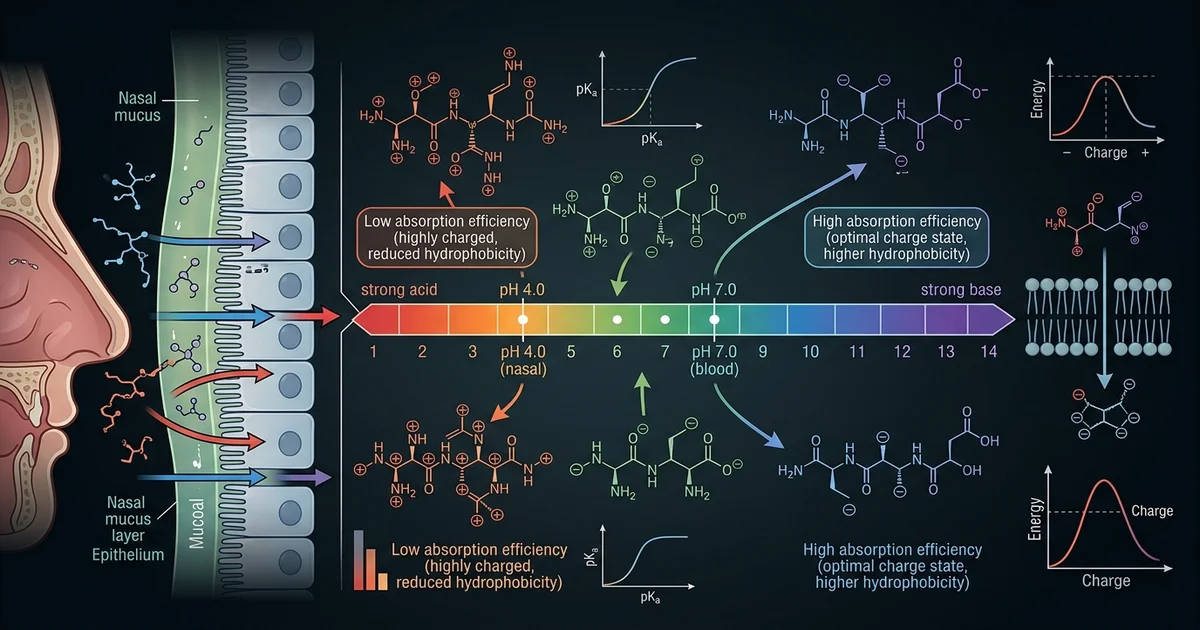
Human nasal secretions maintain a pH that typically falls between 5.5 and 6.5, though this range shifts with health status, age, and anatomical region. The anterior nares tend to be slightly more acidic than the posterior nasal passages. Respiratory epithelium deeper in the cavity often registers pH values closer to neutral. These gradients aren't trivial. A peptide formulated at a pH of 4.5 encounters a very different ionization environment than one formulated at 6.8, and the transition between those environments begins the moment a spray or drop contacts mucosal tissue.
Mucociliary clearance adds another layer of complexity. The nasal cavity clears foreign substances quickly, with residence times for non-mucoadhesive formulations often measured in minutes rather than hours. Ciliary activity sweeps material posteriorly toward the nasopharynx at a rate that varies between individuals. This means even a well-formulated peptide has a narrow absorption window. Researchers studying nasal delivery have pointed to mucoadhesive excipients — substances that increase contact time between the formulation and the mucosal surface — as one practical response to this limitation. Chitosan, hyaluronic acid derivatives, and certain cellulose compounds have all appeared in the intranasal delivery literature in this context.
Enzymatic activity in the nasal mucosa also degrades peptides. Aminopeptidases, endopeptidases, and cytochrome P450 enzymes present in nasal tissue can cleave peptide bonds before a molecule crosses the epithelial barrier. The degree of enzymatic exposure a peptide faces depends partly on how long it stays in contact with tissue and partly on its structural characteristics. Cyclic peptides and those with modified terminal ends tend to show greater resistance to enzymatic cleavage, which is one reason formulation researchers pay close attention to peptide architecture alongside delivery vehicle design.
A peptide's ability to cross biological membranes depends heavily on its charge state at the site of absorption. The relationship between pH and ionization is governed by each molecule's pKa values , the pH points at which a given ionizable group is 50% protonated. Peptides typically carry multiple ionizable groups: alpha-amino and alpha-carboxyl termini, plus side chains on residues like lysine, aspartate, glutamate, histidine, and arginine. The net charge at any given pH reflects the balance of all these groups simultaneously.
Uncharged molecules generally cross lipid bilayers more readily than charged ones. This is why the "pH-partition hypothesis," a concept studied extensively in oral drug delivery research, also applies to intranasal absorption. When the environmental pH is close to a peptide's isoelectric point, the molecule carries minimal net charge and becomes relatively lipophilic in its behavior. Formulation scientists have explored whether adjusting the pH of intranasal solutions to approach the isoelectric point of target peptides improves absorption yields. The challenge is that isoelectric points vary widely across peptide classes, and no single pH optimizes delivery for all compounds.
Short-chain peptides (roughly 2 to 10 amino acids) behave differently from longer sequences. Smaller peptides may use paracellular transport routes , passing between epithelial cells through tight junctions , rather than transcellular routes. Tight junction permeability in nasal epithelium is modestly pH-sensitive, with some research suggesting that slightly acidic conditions affect junction protein conformations. This opens a potential, though not fully characterized, avenue for formulation pH to influence paracellular flux independent of direct ionization effects on the peptide itself.
Buffering is the most direct tool formulators use to control intranasal pH. Phosphate, citrate, and acetate buffer systems each have pH ranges where they operate effectively, and selection depends on both the target pH and compatibility with the peptide and other excipients. Phosphate buffers are common in biological formulations because they operate near physiological pH and have a well-understood safety profile. Citrate buffers offer utility at lower pH ranges and also carry mild chelating properties that can inhibit certain enzymatic pathways.
Tonicity matters too. Hypertonic solutions can temporarily disrupt nasal epithelium and affect mucociliary clearance rates, which has knock-on effects for how long a peptide formulation remains in contact with absorptive tissue. Most intranasal pharmaceutical products target isotonicity , roughly 285 to 310 mOsm/kg , to minimize mucosal irritation. Significant deviations from this range in either direction have appeared in the literature as potential contributors to reduced bioavailability, separate from any pH-related effects.
Permeation enhancers represent a more aggressive formulation approach. Compounds like bile salts, cyclodextrins, and certain surfactants temporarily increase the permeability of nasal epithelium by interacting with membrane lipids or tight junction proteins. These agents can substantially improve the absorption of larger, more hydrophilic peptides that wouldn't otherwise cross the nasal epithelium efficiently. The limitation with most permeation enhancers is that they're not perfectly selective , improved permeability for the intended peptide often means improved permeability for other substances and potential mucosal irritation with repeated use. This is an acknowledged tradeoff in the field, not a solved problem.
Nanoparticle encapsulation has attracted considerable research attention as a strategy that addresses both pH sensitivity and enzymatic degradation simultaneously. Polymeric nanoparticles can shield a peptide payload from enzymatic attack while controlling the pH microenvironment the peptide experiences during transit through nasal mucus. PLGA (poly(lactic-co-glycolic acid)) particles, for example, maintain internal pH conditions determined by formulation rather than external nasal secretions until the payload is released at or near the epithelial surface. Research in this area is active, though much of the published work remains at the preclinical stage.
Understanding intranasal delivery mechanics is especially relevant when considering peptides that researchers believe benefit from avoiding hepatic first-pass metabolism. Subcutaneous injection sidesteps that concern by entering systemic circulation directly, but intranasal delivery offers a non-invasive alternative that's attracted interest in several research subfields. Among compounds discussed in sports medicine and performance research, peptides with central nervous system targets have generated interest in intranasal routes precisely because of the proximity of nasal passages to the olfactory epithelium and the potential for direct nose-to-brain transport pathways. This is a distinct mechanism from systemic absorption and involves different considerations around pH, particle size, and regional deposition within the nasal cavity.
The broader study of peptide bioavailability connects naturally to topics like subcutaneous absorption kinetics and oral peptide delivery research, each of which faces its own set of ionization and barrier-crossing challenges. Intranasal delivery sits between these approaches in terms of invasiveness and bioavailability variability. Practitioners in biohacking and optimization communities have noted that delivery route selection affects not just the amount of a peptide that reaches target tissues but also the timing and consistency of that delivery , factors that matter considerably when protocols are designed around specific pharmacokinetic windows.
Stability during storage and reconstitution also ties back to pH. Peptide bonds can hydrolyze under acidic or basic conditions, with different sequences showing different sensitivities. Formulators working with intranasal peptide products often adjust storage pH to minimize hydrolysis, then rely on buffering to shift the pH toward absorption-optimal ranges at the time of use. This creates a potential tension between storage stability and delivery optimization that doesn't always resolve cleanly.
Human data on intranasal peptide absorption remains limited relative to preclinical animal data. Rodent nasal anatomy differs from human anatomy in ways that affect how readily preclinical findings translate. The nasal cavity geometry, the ratio of olfactory to respiratory epithelium, and the composition of nasal mucus all differ enough to introduce meaningful uncertainty when extrapolating absorption rates or bioavailability estimates from animal models.
Standardization is another persistent issue. Even within published research, differences in spray device design, droplet size distribution, and administration technique create variability that makes direct comparisons between studies difficult. A formulation that performs well when deposited in the upper posterior nasal cavity may behave quite differently when delivered anteriorly. This anatomical targeting problem is not fully solved by formulation chemistry alone.
There's also the question of inter-individual variation. Nasal pH, mucociliary clearance rate, and enzymatic activity all vary between people and shift with factors like allergies, infections, and environmental exposures. Research suggests this variability contributes meaningfully to the wide range of bioavailability values reported across subjects in intranasal delivery studies, but the relative contribution of each factor hasn't been fully quantified.
What the field has established clearly is that intranasal peptide delivery isn't simply a matter of putting a peptide in a spray bottle. The interaction between nasal pH, peptide ionization state, mucosal residence time, and epithelial barrier properties creates a system where small formulation decisions compound into significant bioavailability differences. For researchers and formulators, that complexity is precisely where the meaningful work lies.
For research purposes only , not medical advice.